

2026 TESA Nominee Profile: Saskatchewan— Ralph & Linda Corcoran

Holistic Management: A Long-term Relationship with the Land
A Calling
The story of Ralph and Linda Corcoran’s ranch begins with a simple belief, “being able to do what you want to do.” From the time they were young, both felt pulled toward farming and ranching, a calling that shaped every chapter of their lives.
They married in 1976 and started small, just a few cows on rented land. But their ambitions stretched far beyond those early acres. In 1985, an advertisement in The Western Producer caught their eye: 4.5 quarters of land for sale, but it was more than five hours from home. They made the drive, made an offer, and when it was accepted, they stepped boldly into the next phase of their ranching journey.
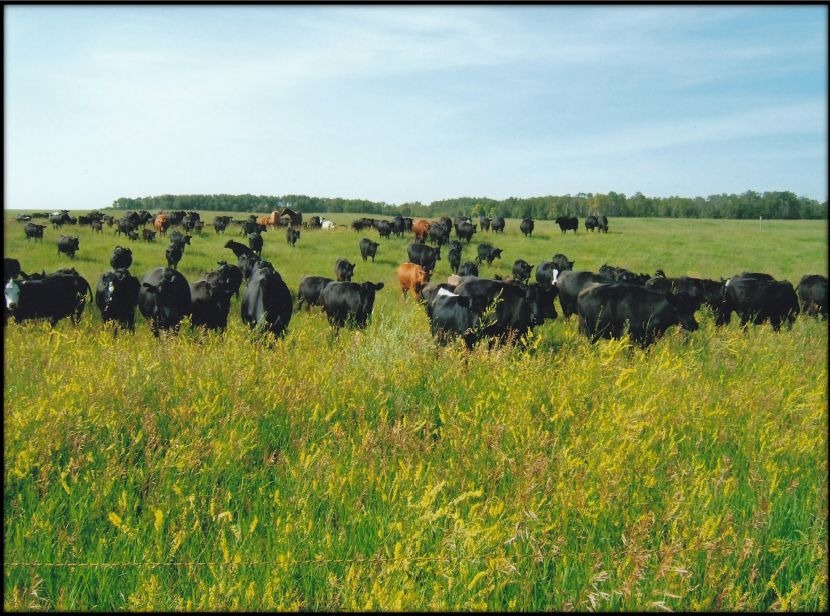
Over the years, they expanded their land base and today run roughly 250 cows across 900 acres of carefully cross‑fenced paddocks. Their grandson Ty Nagy now works alongside them, helping retain heifers, market steers, and managing custom cattle from early May through October.
In the early days, cattle were raised alongside a grain operation. But by 1991, every acre of cultivated land had been converted to grass. They expected to reseed within a decade but something else happened. In 1990, their daughter Haley took a holistic management course, and the principles she brought home reshaped the entire operation.
Today, cattle move through alleyways to dugouts for water and bale graze through winter, with each cow’s intake planned at 3% of her body weight. Different hay qualities support gut health, and bale grazing naturally spreads manure, just as daily summer moves distribute nutrients across fresh paddocks.
Sustainability Practices
The first decade of managing all land as grass was not without challenges. Ralph and Linda watched their pastures decline in both quality and quantity. But when they adopted high stock density grazing and the broader framework of holistic management, the land responded quickly.

With Haley’s help, they designed their first formal pasture plan in 2000. All cattle were combined into a single herd, rotating through 12 pastures, spending about a week in each. Recovery time, not tradition, became the guiding principle.
This shift marked the beginning of a profound turnaround.
Environmental Commitment
Holistic management rests on three pillars: people, land, and profits. Ralph and Linda embraced all three.
Ralph emphasizes the importance of creating an adaptive grazing plan early each year, adjusting it to match rainfall and growth conditions. As he often says, “You can’t build a biological bank account on a dry year.”
Planning around moisture ensures grass for their own herd and peace of mind for custom cattle owners.
They also credit the previous landowners for planting long rows of shelterbelt trees, now thriving wildlife corridors. Sloughs across the property support waterfowl and contribute to a rich, biodiverse landscape.
Community
Ralph and Linda’s commitment extends beyond their fencelines. They helped form the SOLAR Holistic Management Club, hosted tours with Sask Soils and international delegates, and welcomed groups from the Canadian Forage and Grasslands Association (CFGA) and other holistic clubs for pasture tours.
Their expertise and willingness also opened doors to new partnerships. Partnering with the University of Saskatchewan, University of Alberta, and University of Wisconsin, they supported three major studies measuring bird species, plant diversity, water quality, soil health, and carbon levels. While the first tests were simply baseline numbers, subsequent three‑year interval testing revealed measurable improvements, proof that their management practices were working.
One of the most striking findings was the abundance of bird species, which was three times higher than typical counts in the region.
The Future
In the spring of 2026, Ralph and Linda sold the ranch to their grandson Ty, passing on not just land, but a legacy. They plan to stay involved, helping him refine pasture plans and continue improving both cattle and grass health.
They’re also eager to bring in a plant specialist to identify current forage species. Over the years, they’ve adjusted recovery periods based on what they observed, lengthening rest when alfalfa was low, for example, and they want to deepen their understanding of the plant communities they steward.
Biological Bank Account
Looking back across decades of change, challenge, and growth, Ralph and Linda’s ranching journey stands as a testament to what intentional stewardship can accomplish. What began as a young couple with a few cows on rented land evolved into a thriving, resilient operation shaped by curiosity, courage, and a willingness to rethink tradition.
Even in moments of industry-wide hardship like the BSE crisis, their approach proved its worth. While many struggled to feed their herds, Ralph and Linda’s carefully managed grasslands supported twice the usual number of cattle without strain. Their ‘biological bank account’, built through years of thoughtful planning, paid dividends when it mattered most.
Now, as they pass the ranch to their grandson Ty, Ralph and Linda step into a new role as mentors, guides, and proud witnesses to the next generation. They hope the legacy they leave is not just a productive ranch, but a way of thinking; that planned grazing, patient observation, and a willingness to learn can transform both landscapes and livelihoods. That biodiversity is not an accident, but a reward. Healthy cattle begin with healthy grass. And the land, when managed with intention, gives back more than it takes.
Their story is proof that holistic management is not a trend; it is a long-term relationship with the land. One that, when nurtured, creates abundance, resilience, and a future worth passing on.


Comments