

CCA Committee Close-up


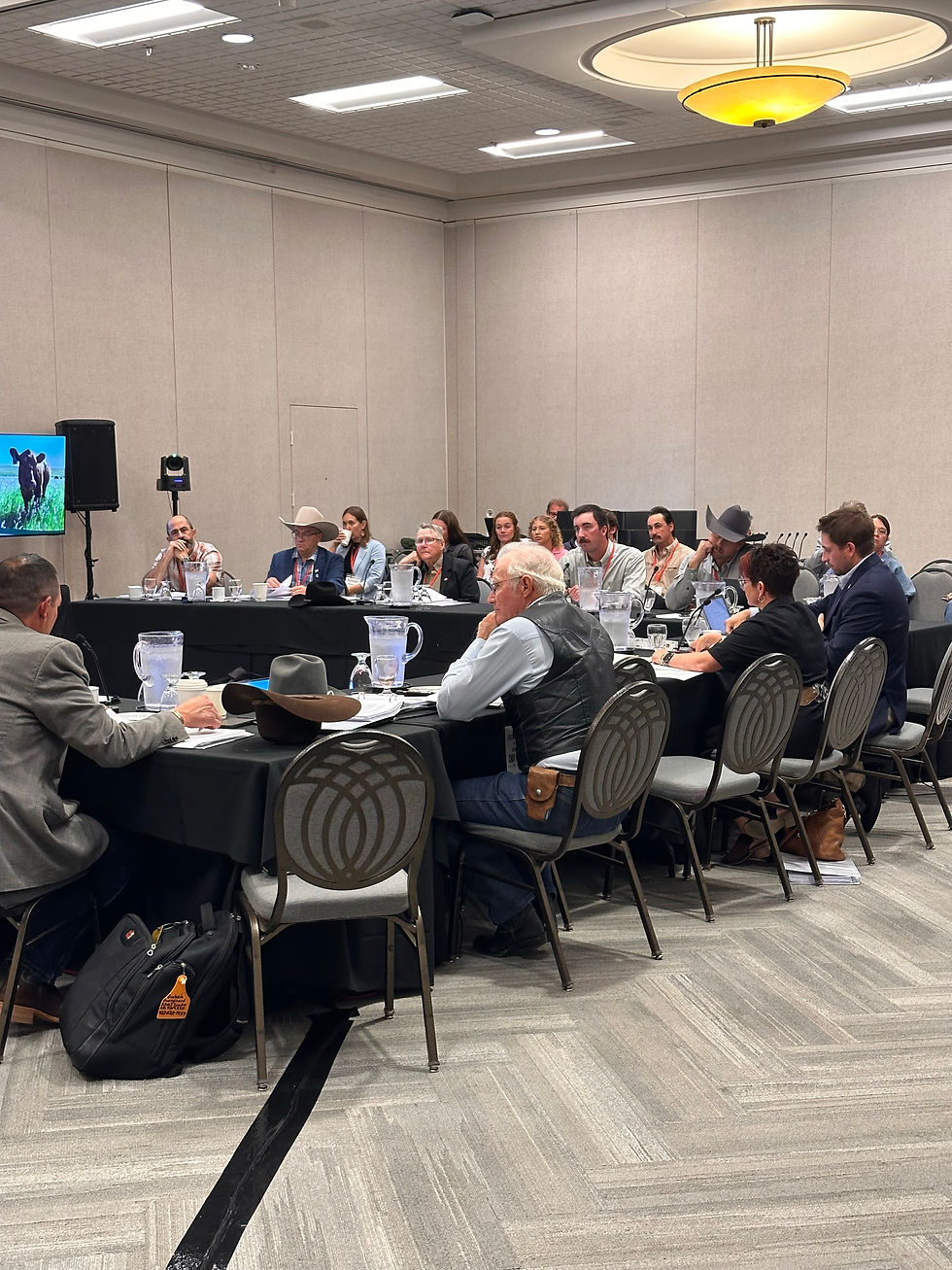
The Canadian Cattle Association system of governance is a policy board, meaning that directors are responsible for setting policy and monitoring it for relevancy, accuracy, and achievement over time. CCA has five committees: Animal Health and Care; Domestic Agriculture; Environment; Food Policy; and Foreign Trade. These committees cover the subjects that affect Canadian beef cattle competitiveness and opportunity. Each committee has two co-chairs and is assigned staff who support the committee and are responsible for monitoring developments and activities relevant to the committee, conducting necessary research, arranging guest speakers and expert consultation as needed, and leading or guiding the CCA work to achieve desired outcomes.
Committee members are not necessarily members or directors, but all directors must sit on at least one CCA committee. Committees sometimes bring in expertise from the industry such as Livestock Markets Association of Canada and Canadian Beef Breeds Council.
Here is a closer look at recent committee activity.
Animal Health and Care
What is this committee responsible for?
The Animal Health and Care Committee supports the CCA Board of Directors by monitoring current issues and trends in animal health, animal care, and welfare, including relevant legislation and regulation, research, and international standards bodies, and by debating and recommending CCA policy positions. The Committee promotes policies that mitigate the threat of foreign animal diseases, protect the health of Canada’s domestic cattle herd, and strengthen confidence that Canadian beef production practices support animal welfare. It advances disease prevention and preparedness through biosecurity, surveillance, and traceability, and advocates for practical, feasible approaches that support market access and do not unnecessarily impede trade.
Featured speakers at the AGM
Dr. Suminder Sawhney (Senior Director, CFIA International Affairs), update on animal health and trade issues, including CFIA reorganization, New World Screwworm monitoring, FMD detections in Europe, IBR testing advocacy, and SRM alignment progress
Dr. Karen Schwartzkopf-Ganswein (AAFC), Scientific Committee update for the Beef Code of Practice, including findings on painful procedures, weaning practices, pain management effectiveness, and research gaps
Matt Bowman (Chair, Code Development Committee), Beef Code development process update, including consensus approach and upcoming public comment period

Highlights from the March committee meeting
Traceability—CCA position and next steps: Following the Traceability Dialogue Day, the committee advanced a recommendation to the Board that CCA not support the proposed amendments to Part XV of the Health of Animals Regulations as currently drafted. The committee reaffirmed traceability as a core pillar of CCA’s work and committed to convening a national traceability task force, including provincial representation, to guide next steps. CCA's official statement can be found at www.cattle.ca/cca-statement-on-proposed-federal-livestock-traceability-regulations-2
Beef Code of Practice development update: The committee received an update on the Code development process and noted that the public comment period was expected to open April 13, 2026, and remain open for 60 days. Members emphasized a strong need to increase producer participation during the comment window. The Code of Practice Public Comment Period opened as anticipated on April 13 and will be open through June 12, 2026. More information is available at www.cattle.ca/beef-code
Regulatory update—CG1/CG2 and SRM proposal: Government indicated it is targeting CG1 publication in spring (aiming for June) with an anticipated 30–90 day comment period. Timing for CG2 will depend on stakeholder feedback and trading partner responses. The current proposal would narrow Canada’s SRM list to align with the U.S. tissue list, shifting some tissues from SRM (landfill-required) to prohibited material (PM) that may be eligible for alternative handling pathways. for non-ruminant feed, pet food, fertilizers, improving value recovery and competitiveness.
Domestic Agriculture
What is this committee responsible for?
CCA's Domestic Agriculture Policy and Regulations Committee, more commonly referred to as Domestic Agriculture, deals with non-trade-related regulatory issues, including general government policy, business risk management programs and other regulations affecting cattle production. This committee also makes representation to the government and works with other committees or groups on issues of mutual interest.
Highlights from the March committee meeting
The Committee priorities include business risk management (BRM) programs, the Next Policy Framework, and the impacts of recent federal research cuts.
The Committee updated its policy on research to call on Agriculture and Agri-Food Canada (AAFC) to provide a minimum of five years of program and salary funding to support the orderly transition of the Meat Science research program at AAFC Lacombe and the Forage Breeding research program at AAFC Quebec City into Canadian universities with appropriate agricultural faculties and facilities. CCA will also be advocating for more federal government support for industry-led extension work.
AAFC officials presented a feasibility report on the potential of whole‑farm revenue insurance. CCA’s understanding is that this could eventually be looked to as a replacement for the current AgriStability program. The report confirmed such a model is viable in Canada with a goal of addressing long‑standing producer concerns around timeliness, predictability, and equity. Stackable or top-up insurance programs and coverage options could be developed, including commodity-specific production or price coverage. For beef, two distinct products—cow‑calf and feedlot—were identified as feasible to offer coverage comparable to current livestock price insurance with a potential for cost-shared premiums. Although years away, the committee is doing a deeper dive over the coming months to evaluate if this is a business risk management program model the cattle industry would support.
Members also reviewed recent AgriStability updates. Starting in the 2026 program year, pasture rental is now an eligible AgriStability expense and provinces have the option to implement P2 inventory pricing. These are both program enhancements CCA advocated for to bring the program in alignment with what producers experience on the ground, especially in drought situations.

On the Advance Payments Program (APP), CCA continues to advocate to permanently raise the interest‑free portion to $350,000. While the federal government announced April 1 that it would maintain the $250,000 interest‑free limit for 2026 on non‑canola advances, CCA will continue pushing for a permanent, predictable increase. The committee also supported a policy resolution brought forward by the Manitoba Beef Producers calling for greater APP flexibility to secure cash advances, including recognition of in utero calves, as well as adjustments to repayment periods to allow for early repayment.
Looking ahead, discussions on the Next Policy Framework highlighted priorities such as more equitable BRM programs, water infrastructure, wildlife damage compensation, innovation and research, assurance programing, and much more. The Next Policy Framework will replace the current Sustainable Canadian Agricultural Partnership (SCAP) funding framework that comes to an end in March 2028. These provincial/territorial/federal negotiations require lots of runway. The CCA continues advocacy priorities leading into the federal, provincial and territorial Ag Ministers meeting in July.
Finally, the committee also renewed several long‑standing policies surrounding succession and tax planning, continued membership in the Canadian Agricultural Human Resource Council to address workforce challenges, and BRM guiding principles.
Environment
What is this committee responsible for?
The committee's mandate is to understand how environmental issues affect beef production in Canada and encourage environmentally sustainable production practices. This committee also interacts with environmental stakeholders on the role beef production in Canada plays in soil and water health, wildlife habitat, biodiversity, and that cattle producers are responsible custodians of the animals they own and the natural resources they utilize.
Featured speakers at the AGM
Jordan Graham, Physical Science Officer, Environment and Climate Change Canada (ECCC)—presenting on the Reducing Enteric Methane Emissions (REME) in Beef Cattle Federal Offset Protocol
Amie Peck, Public and Stakeholder Engagement (PSE)—presenting an update on the 2026 North American Grazing Lands Congress, a co-hosted event with the United States Roundtable for Sustainable Beef (USRSB) to celebrate 2026 as the International Year of Rangelands and Pastoralists (IYRP) and showcase North American beef sustainability
Highlights from the March committee meeting
The CCA Environment Committee finalized its "Grazing Lands Guiding Principles", a document that has been in development for more than 18 months. It was recommended to the CCA Board and passed as policy. Canada’s grazing lands support biodiversity, habitat connectivity, clean water, species at risk, and other ecosystem goods and services, while underpinning the social and economic viability of ranching communities. The health of these ecosystems is often dependent on the ability of cattle or other large grazers to drive ecological processes. Maintaining these ecosystems as working landscapes directly strengthens environmental resilience and the livelihoods that depend on them. These principles guide collaborative, voluntary approaches and will help develop diverse tools that enable producers to steward grazing lands effectively, in ways suited to their regional contexts and operations.
Food Policy
What is this committee responsible for?
The Food Policy Committee is designed to monitor, shape and advocate policies that accurately represent the beef industry. The committee’s work is broad and covers multiple agencies and files ranging from labelling, nutrition, international policy, and emerging technologies. The committee's mandate is to find ways to ensure there is proper and accurate labelling for food and a strategy to promote across institutions the benefits of beef for nutrition and the environment.
Highlights from the March committee meeting
The committee secured a visit from the Food and Agriculture Organization of the United Nations (FAO) Director General to Canada —the highest authority at FAO— to attend the North American Grasslands Conference in Calgary.
The committee worked hard behind the scenes and ultimately made substantive contributions to FAO’s Global Action Plan on Sustainable Livestock. Their work helped to assure that the producer perspective and voice is reflected in this global action plan.
Food policy is at the intersection of global deliberations and reports, domestic nutrition guidelines, approval of technologies, and how consumer preferences and perceptions impact government’s agenda. Discussions also cover emerging issues and opportunities and how the beef industry can respond to policies that affect producers outside of trade, animal health and environment such as novel technologies, nutrition and international engagement.
Foreign Trade
What is this committee responsible for?
The Foreign Trade Committee focuses on expanding and defending international market access for Canadian beef. CCA wants to ensure that the Canadian beef industry has favourable access to international markets and is not exposed to unfair competition. This committee also works towards eliminating programs, measures and subsidies around the world that distort trade.
Highlights from the March committee meeting
Much of the recent meeting was devoted to discussing concerns about a pending trade deal between Canada and Mercosur. While reciprocal and rules-based trade diversification is supported, diversification should not come at the expense of Canada’s domestic production base or our most important trading relationships—and this potential trade agreement threatens both.
The committee made a recommendation to the directors that CCA take a firm position opposing a trade deal that will negatively impact Canadian farmers and ranchers and instead incentivize increased beef production in other countries where standards are much lower. This recommendation was accepted, and CCA launched a campaign requesting support from Canadians. This campaign includes the website www.cattle.ca/mercosur which provides supporters with an easy way to contact their MP to share their concerns, an email outreach campaign to beef advocates who have expressed a desire to support Canadian beef producers, and a series of posts on social media designed to raise awareness and encourage action.
Another significant topic of discussion at the meeting was U.S. advocacy. CCA continually advocates for continued integration of the North American cattle market and ongoing tariff-free access for Canadian cattle and beef. The United States is not only our largest trading partner, our beef market is highly integrated with cattle crossing the border back and forth throughout their life cycle, from genetics before conception through processed meat products. This integration and the importance of our relationship with our neighbours is why much of CCA's foreign advocacy is focused on the United States.
CCA staff and elected officials regularly attend meetings in Washington, D.C., in person, via video and on the phone. We meet with domestic stakeholders and grow those relationships—which are critical to maintaining market access. CCA organizes meetings with federal and state level governments and organizations in the U.S., working with provinces to build relationships at all levels. Throughout 2025, CCA focused on the CUSMA/USMCA review, ensuring governments are fully informed on the integration of the North American beef cattle market and the importance of continued free trade.

Comments